The PicRights "Trap": A Warning for NZ Businesses & Lessons Learned
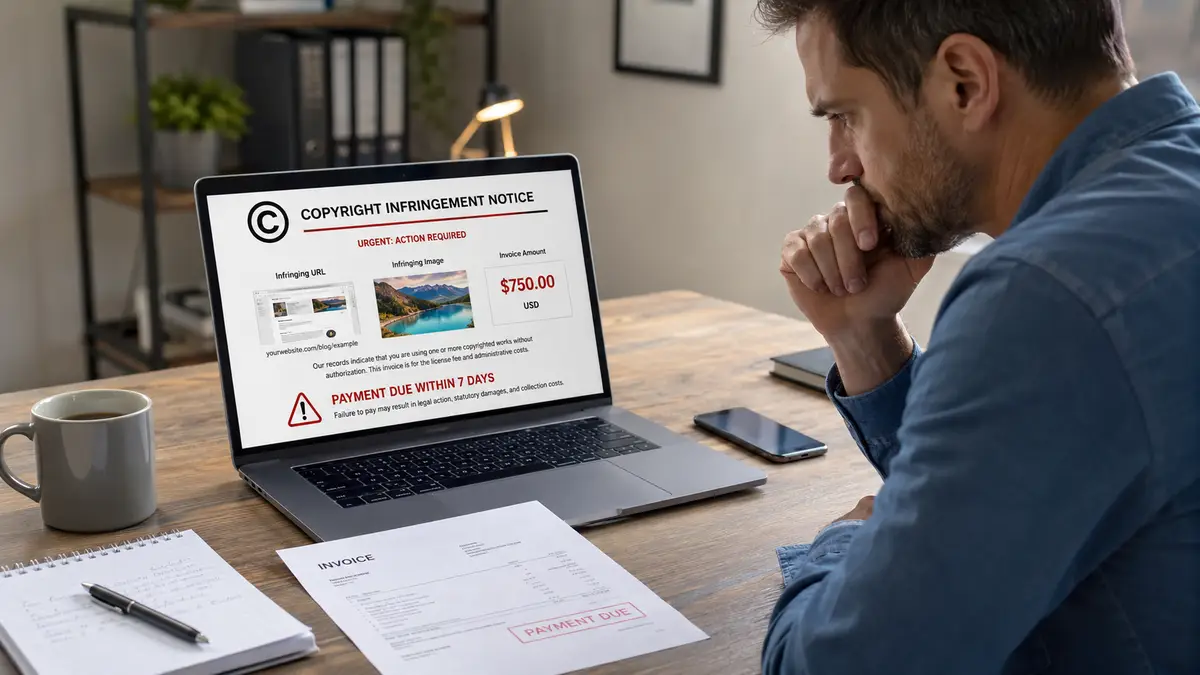
Important disclaimer: I am not a lawyer (a bit like the collection officers of a certain company…).
Nothing in this article is or should be construed as legal advice, and I advise you to consult your lawyer if faced with a PicRights claim-or a similar claim from any such copyright “enforcement” company, of which there are a number.
If you run a website in New Zealand, you may one day receive a formal-looking email from PicRights Australia Pty Ltd, which I understand to be a subsidiary of PicRights Europe GmbH.
In January 2026, I navigated this process myself. While I started by acknowledging my own rather minor mistake (I will discuss more about the potential pros and cons of doing this in the first place), the tactics that followed were a massive wake-up call regarding “speculative invoicing” and what many term “copyright trolling”.
My experience with these tactics even recently led to me being interviewed by the National Business Review (NBR) for a feature on PicRights’ practices in New Zealand. You can read the NBR article here, although it is behind a paywall (and no, I will not share it for free, and yes, you should sign up and pay for NBR as it is very good). Funnily enough, according to one of the NBR team I spoke with, a PicRights representative actually had the cheek to ask if they could be given free access to read the article as they couldn’t get around the paywall … make of that what you will.
Doing some research led me to learn how widespread this issue is among Kiwi and overseas business owners, bloggers etc, and therefore prompted me to write this comprehensive breakdown of my experience.
In this article, I’ll document my experience with PicRights, outline my concerns regarding their manner of dealing, and close with some general advice on how to avoid or handle this type of problem.
Why Am I Writing This?
I want to make it clear that I am not writing this as some form of ‘sob story’ or woe-is-me piece. I did actually make a mistake - albeit a very common one that I’m sure almost everybody who has ever used the Internet has used - and I wanted to right the wrong, as I do believe in concepts such as copyright and intellectual property.
That being said, I also do not believe that two wrongs make a right.
As you will see from this article (and as I suspect you have experienced firsthand if you found your way here by Googling “is PicRights a scam”, “is PicRights legit”, or “do I need to pay PicRights”), the behavior of this organization leaves a sour taste in the mouth, to say the least.
The crux of my frustration isn’t that rights-holders want to be compensated fairly. For example, I recall once in the past I had uploaded an article to a website I ran, which had been written by a freelancer. Said freelancer had provided me an image which I had just assumed they had the rights to use (I know, I should have checked). Anyway, a few months later I got an email from a very legitimate looking law firm out of the United States, saying “you need to take down this image, or you can keep it up and link to us to attribute, or you need to pay if you want to use it without crediting us”. I could hardly say fairer than this approach, and the lawyer/representative I dealt with was extremely courteous and reasonable in all dealings.
With PicRights, the complaint is really about the fundamental conduct of their business - being pressured into paying an arbitrary sum of money to an aggressive, uninvited third-party enforcer with whom you have no pre-existing contract or relationship, under threats of legal escalation … with no ‘good faith’ way of resolving the problem outside of paying whatever they demand.
The Volume Of Picrights & Other Image Copyright Claims Appears To Be Increasing
I am also writing this because the volume of claims being sent out appears to be escalating, and as such I want to forewarn more business owners and webmasters as the net appears to be widening. I base this on seeing more and more comments on platforms such as LinkedIn or Reddit, where both Kiwi and overseas business owners, website owners etc are “complaining” of having been stung by a copyright infringement claim. Google Trends tells me that globally, there has been a near 500% increase in search interest relating to PicRights in the last five years, most of the increase coming since 2024.
I suspect a few converging factors are driving this increase in these claims (and the 2024 bit becomes more pertinent in the following context)
-
Technological improvements, including AI, have likely made it easier than ever before to identify infringing image usage. In other words it is faster, easier, and more reliable to trawl the Internet using bots and scrapers to find images and send out demand letters. Easily scaling infringement detection and increasing the volume of demand letters sent are integral to this business model.
-
Image creators are feeling the pinch. As businesses and website owners turn to AI for illustrative and editorial images - just look at the explosion of those typically awful AI generated restaurant flyers and menus - the pool of paying customers for traditional stock is undeniably shrinking. The hardest hit are easily replicable concept art and “typical” stock imagery - those deliberately bland, inoffensive setups we’ve all used in the past, like “two businessmen shaking hands” or “hand on a computer mouse”. While this middle tier of the conventional stock industry gets hammered - backed by widespread reports of slashed revenues and platform layoffs - the broader market is actually bifurcating, according to the research I’ve done. There is strong evidence that premium, hard-to-replicate licensable imagery is thriving. As AI floods the internet, buyers are actively seeking out authentic, human-shot photography to elevate their brands above the new, artificially generated norm (a trend supported by recent market data showing traditional photos still maintain significantly higher sell-through rates than their AI counterparts). However, the damage to the generic, typical stock imagery market is clearly significant.
-
What this means is that in an era when many image creators are selling fewer licences (because those customers are oftentimes using AI instead), it is easier than ever before to find examples of non-licenced image usage … which means that one of the remaining revenue and profit growth centers for image creators is to try and recover “lost” licence revenue from users who haven’t paid for the right licence to use an image … and that’s where PicRights enters the equation.
Who are PicRights and How Do They Work?
PicRights is a global copyright enforcement company that acts as a “middleman” for media organizations like Reuters and the Associated Press, as well as smaller independent media outlets and creative artists.
PicRights specializes in what they call ‘post-licensing’-basically enforcing image rights licensing “after the fact”.
Their operation basically works as follows (from what I can gather)
- The Discovery: They use sophisticated image-recognition bots to crawl the internet and identify unlicensed uses of their clients’ images. One would assume this is becoming easier than ever before with the power of AI.
- The Email Claim: You receive an email titled “Copyright Infringement Notice” containing a screenshot of your website, the original image from their client’s catalog, and a demand for payment-often reaching hundreds or thousands of dollars. They make it clear that simply removing the image is not enough - you must pay the claimed some to effectively compensate for the past use of the image.
- The Payment Portal: The email directs you to an online portal where you are pressured to either provide a valid license number or “settle” the claim by paying their stated fee via credit card or bank transfer. In order to settle you must also agree to various terms, notably that you won’t disclose the final settlement amount and specific terms (unsure what would happen if you did, but I’m not eager to find out).
The entire system is designed to place you under intense pressure to settle for a specific sum, or else face escalation to lawyers where fees will supposedly multiply.
Is PicRights Legitimate?
When you first receive an email from PicRights, your immediate reaction might be to assume it is an elaborate phishing scam - and looking at their endless wall of one-star online reviews and scathing social media commentary certainly will not change your mind. However, PicRights is not a scam in the traditional sense (at least not in my opinion). I have been clear about that elsewhere in this article. They legitimately partner with major media syndicates like Reuters and the Associated Press, as well as smaller image creators and rights holders, using sophisticated automated web crawlers to track down unlicensed image usage across the internet. The issue is not whether they have the right to enforce copyright; it is how they recover licence fees that should have been paid and whether that process is reasonable, fair, and even enforceable. Their business model relies heavily on what many call “speculative invoicing” or “copyright trolling”. By exploiting the strict liability nature of copyright law, they cast a massive net using bots, slap arbitrary markups on top of standard licensing costs, and rely on pressure tactics and tight deadlines to try to force a quick settlement.
Is PicRights A Law Firm?
No.
To their credit, they are at least very up about this. PicRights is not a law firm, and its “compliance officers” are not lawyers.
The compliance officer I dealt with was based in Toronto, operating on behalf of an Australian subsidiary of a European parent company to enforce a claim in New Zealand on behalf of a US-headquartered media giant (Reuters).
If you do not pay or prove you had a license, they claim they will escalate your case to partner law firms in your local jurisdiction.
Is PicRights A Scam?
No, I’m not going to support that common claim.
PicRights isn’t a scam in the conventional sense of phishing attempts or fake invoices for services never rendered … although I can see why you might initially think so, particularly if you Google the name and see all the reviews (more on that later).
I have dealt with this sort of thing in the past - receiving email-based demands for images on websites I’ve never owned or worked on, or for images clearly never used. PicRights is legitimate, and different.
As far as I can tell, they legitimately partner with image rights holders to basically identify unlicensed usage, and then recover the lost licence fees and in the process keeping whatever is made on top (I don’t actually know how the specific financial aspects work, but most commenters seem to agree that this is how it works, i.e. if a licence should have cost $100 and PicRights gets you to pay $500, then they keep $400 and remit $100 to the rights holder).
For the rights holder(s) it’s not hard to see the benefits. For presumably no up front cost, on an effective ‘no win no fee’ basis you get the chance to recoup lost revenue, and because of the amount of unlicensed image use on the Internet there is a huge pool of potential opportunities, so to speak.
Compare this to, for example, having to engage a lawyer or similar on a retainer or hourly basis to pursue unlicensed image usage - there’s every chance you might wrack up a large bill without receiving any recovered licence revenue, so it’s not hard to see where the value proposition of a system like PicRights comes from.
While not a scam in my view, I have seen various arguments that their model constitutes a clear example of copyright trolling (interestingly enough, they are at great pains in an article on their website to point out that they are not copyright trolls …). Another term sometimes used is ‘speculative invoicing’ which is perhaps fairer again as a PicRights demand is ultimately nothing more than an invoice sent to you, which they might be able to get a court to force you to pay if things escalate because there is an underlying copyright infringement.
The business model relies on:
- Mass Automation: Casting a wide net using automated web crawlers. No stone is left unturned in trying to find a potential infringement, no matter how minor or unintentional or clearly non-commercial (e.g. a local church makes the mistake of uploading a copy of its monthly printed newsletter - probably still made in MS Publisher - to the church website, said newsletter contains some little stock image used in an illustrative, non-commercial manner, but because it can be found on a server PicRights gets a claim in. I’ve even seen an example where a business used an image in an internal slide deck, had it hosted on a supposedly private server but somehow the slide deck was visible if you got the right link, and they got pinged for that).
- Strict Liability: In most jurisdictions, intent doesn’t matter. If an image is on your site, you are liable. This is one of those ‘gotchas’ with copyright law where the nature of the law itself probably hasn’t caught up with the public zeitgeist. We (as in everyday people) are used to an Internet - and many of us have grown up with an Internet - where using imagery found online is just ‘par for the course’ and nobody thinks twice about it and nobody really sees anything wrong in it. Finding an image online and using it in a ‘non-commercial’ capacity to illustrate a point in a social media post, forum post (remember forums?), blog post or whatever is - despite what the law says - simply not seen as a problem. Most would understand that taking an image and then commercialising it is different (e.g. downloading an image and reselling it) but very few would see a problem from a moral/philosophical point of view with mere non-commercial/illustrative use of an image … but that is where strict liability comes in, and clearly in favour of PicRights and its clients.
- Fear & Friction: Demanding an arbitrary fee with tight deadlines, counting on the fact that paying a few hundred dollars is cheaper and less scary than hiring a lawyer to defend yourself, or running the gauntlet of potentially massive damage awards if things go to court. This aspect is key; as you will see, every single communication, every facet of the experience is geared towards pressuring you into settling.
Admitting the Mistake
In January 2026, I received a PicRights demand email regarding an image of legendary boxer George Foreman that was used as a header graphic on an old blog post on my business website (samfrost.co.nz). I used the image to illustrate a point/argument, and to be honest thought I’d be fine enough to use it as it was a very old image by that time and I had seen it posted everywhere from Reddit to Facebook to Instagram and beyond.
I accepted my mistake immediately. Copyright is a “strict liability” issue in New Zealand - it doesn’t matter if the use was accidental or done years ago. I am not going to argue with the statute books. I took down the image and unpublished the post within 10 minutes of reading the email.
However, PicRights informed me that removing the image was insufficient (they are at great pains in their emails, on their website etc to re-iterate this point); a substantial financial payment was required to make the problem go away.
The Documentation vs. The Reality
When I received the initial demand for $700 NZD - a not insignificant sum - I felt the sum was completely disproportionate to the real-world value of the image usage:
- It was a single, low-traffic blog post header (Google Analytics showed literally one lifetime visitor … me).
- The post was purely informational/editorial- I was not selling George Foreman merchandise or incorporating the photo into a commercial product. PicRights themselves admitted the usage was editorial, the exact wording in the email being: “In this instance, you have used the Image for editorial purposes “
I asked PicRights to justify how they calculated this figure of $700.
At this juncture, I want to draw a comparison to the common argument I’ve seen used on forums such as Reddit’s /r/copyright (which is frequented a seemingly equal number of PicRights claim defendants, and rights holders who use the system and are very much in favour of it):
“If you steal an item from a store, it costs far more to settle than the upfront price, so why should digital use be any different?”
This comparison completely breaks down on two fundamental grounds:
- Copyright infringement is legally and conceptually distinct from physical theft. In a shoplifting scenario, the shopkeeper is permanently deprived of a physical asset and its retail value. Believe it or not, I actually trained for a while to be a police officer (before going down a different career path which has led to where I am today). I didn’t much enjoy the pepper spraying and tasering, but I did enjoy the legal bookwork. I can still remember rote learning the key aspects of theft as a crime; it requires dishonestly taking physical property without a “claim of right” (meaning no genuine, even if mistaken, belief that you were allowed to use it … in image copyright disputes there is often a very genuine, albeit mistaken, belief you were allowed to use the image), and crucially, doing so with the intent to permanently deprive the owner of that property. Digital copying, by contrast, is non-rivalrous - the creator retains full possession of the original image and remains entirely free to license or sell it to anyone else.
- Victims of physical theft cannot arbitrarily invent their own penalties. If someone shoplifts a $2 chocolate bar, the supermarket owner cannot simply send them a private invoice demanding $20 on a whim. And a random third party with whom the supermarket has a contractual relationship but the shoplifter does not, can certainly not demand $20. The criminal justice system handles theft, and legal reparation is strictly limited by statute to making the victim whole based on their actual loss ($2). In contrast, at least based on my experience, post-licensing agencies like PicRights bypass standard commercial market rates to demand arbitrary sums.
PicRights initially refused to give any meaningful calculation or breakdown of how the figure was arrived at. As opposed to a normal business that might explain how its charges are calculated.
In my experience, you cannot get them to budge on this and clearly state in some broken-down manner (licence cost, compliance fee, admin fee etc) how the demand is structured … and some of the demands I’ve seen online are into the thousands of dollars.
After further emails, I got the following:
“As previously noted, assessed settlement amounts for unlicensed usage are set by the respective copyright holders, not by PicRights. They are based on the standard fees the copyright holders charge their paying customers for similar uses. Our client sets the pricing for the images they license. These fees are based on a number of factors, including how the image is being used, where the image is placed, and for how long the image was used for.”
PicRights also publicly states-on their website, social media, and in their standard email correspondence-that their fees are strictly tethered to standard licensing rates:
“The fees requested by PicRights are based on the amount our clients would normally charge for the same use of the work.” (https://picrights.global/picrights-is-not-a-troll-copyright-affects-everyone-including-you/)
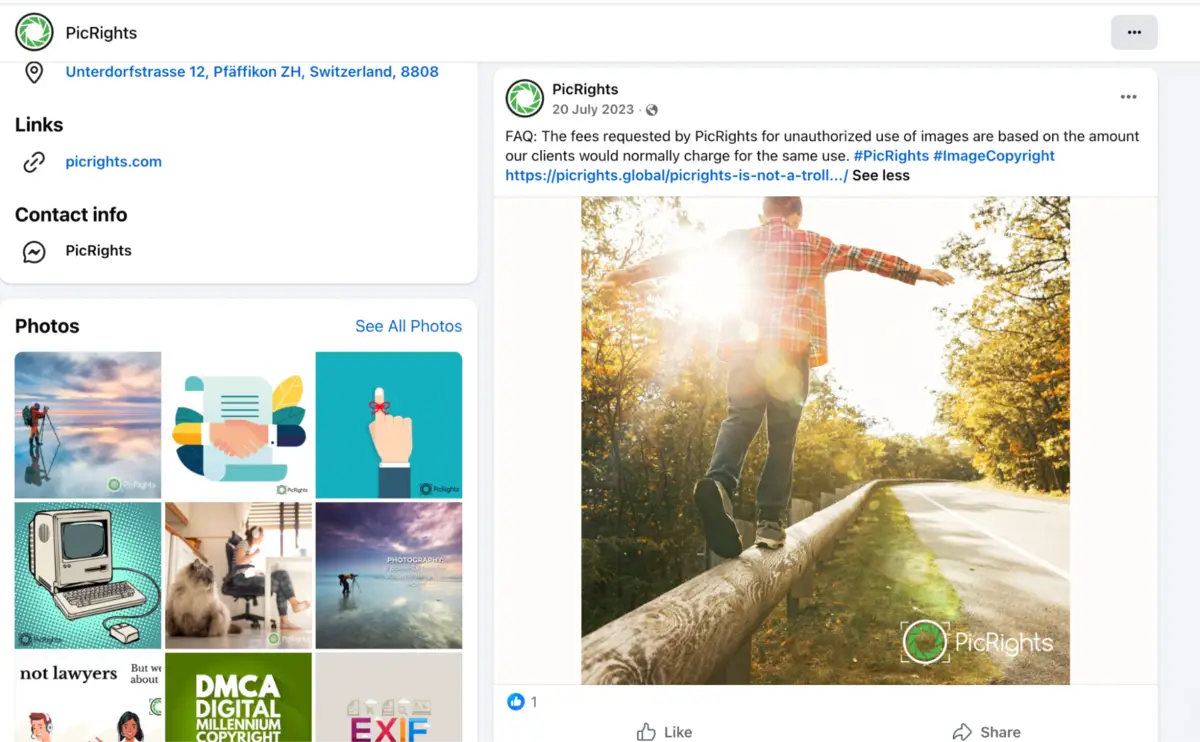
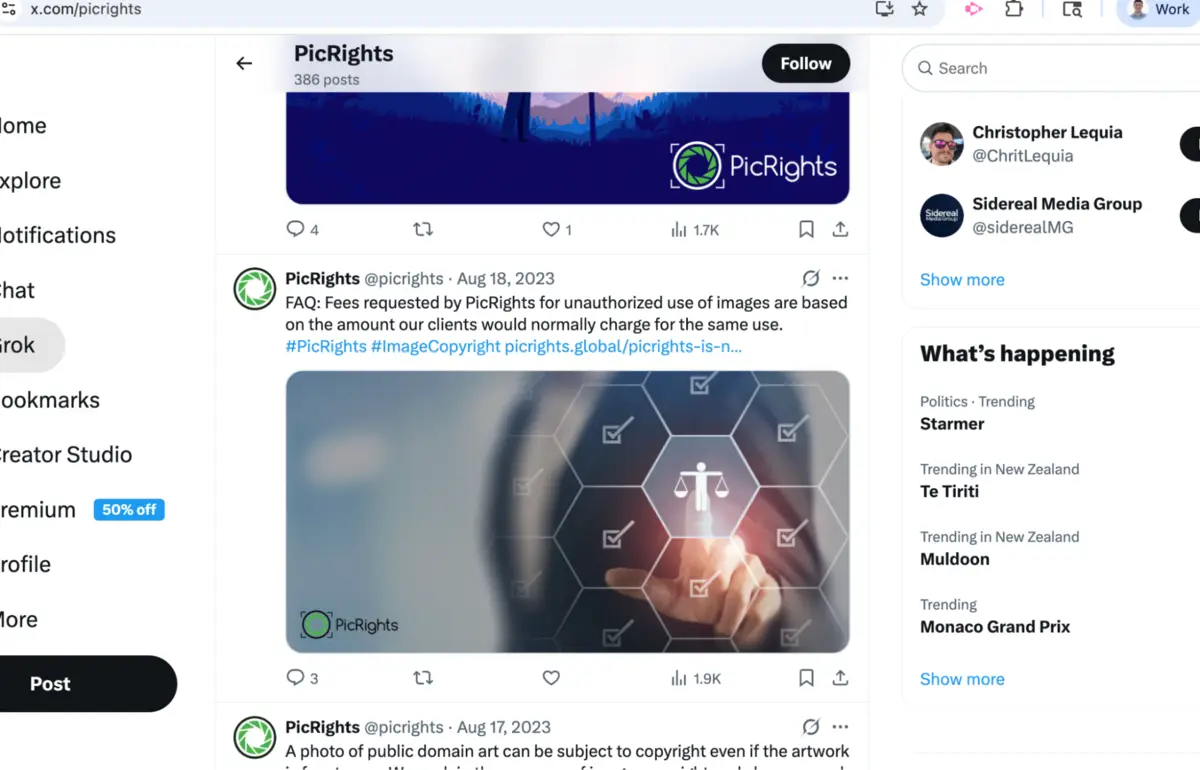
When I pushed back via email and asked for actual documented proof of what Reuters would charge for this specific use (not “take our word for it, Reuters want $700” but actually “show me an invoice or quote from Reuters proving the $700 figure” the compliance officer responded with standard boilerplate rhetoric:
“The fee requested is based on our client’s standard licensing rates for the unauthorized duration and scope of use”
I appreciate that ‘based on’ allows for some wiggle room. But to any normal person, a charge approaching many multiples of that of the underlying licence value (more on that shortly) is well beyond the realms of a reasonable ‘based on’ figure.
In other words, if McDonald’s decided a single cheeseburger was suddenly $20 ‘based on’ the underlying value of the ingredients and labour cost, you’d fall off your perch laughing.
The “Parking Meter” Metaphor: Worse Than Wilsons Parking
To understand why PicRights’ approach feels so deeply unreasonable to a business owner, consider an everyday commercial comparison that every Kiwi will recognize: private parking enforcement.
New Zealand motorists are no strangers to companies like Wilsons Parking. We might grumble when we see a $65 breach notice on our windscreen, but legally speaking, Wilsons Parking’s business model actually holds up under New Zealand law - and understanding why it holds up makes PicRights’ model look even worse.
Under landmark contract rulings - specifically the NZ Supreme Court decision in Honey Bees Preschool [2020] and the following UK benchmark ParkingEye [2015] - courts established that private parking operators can legally charge standard breach fees (typically $65–$85 in New Zealand) provided two strict criteria are met:
- Contractual Consent: They erect giant signs at the carpark entrance displaying the terms and breach fees before you enter. By driving onto the land, you legally accept those terms and enter into a contract.
- Proportionality: The fee is not purely punitive; it protects a “legitimate commercial interest” (managing turnover and keeping the carpark operational) and stays within a standardized, reasonable dollar range.
PicRights fails spectacularly on both counts.
- Zero Prior Contract: You never signed an agreement or drove past a giant “PicRights Terms & Conditions” sign when you published a blog post containing an image. They are an uninvited third party demanding money after the fact for an unproven civil dispute, not enforcing an established contract.
- Grossly Disproportionate Fees: While a $65 parking fee covers basic administrative overhead, PicRights’ demands are completely out of proportion. They take an image with an actual market value of say $100 and unilaterally slap on a 1000%+ markup (based on some examples I’ve seen) with zero contractual authority with the ‘defendant’ or clear statutory right to do so. I could certainly see how something like $100, on top of the underlying licence fee, could be seen as a reasonable fee to protect their legitimate commercial interest, but the sums asked are typically astronomical compared to the underlying licence value.
To put it in everyday parking terms: imagine overstaying a $3 council meter by 15 minutes.
Instead of getting a standard $15 council ticket, an uninvited, overseas enforcement company blocks your car and emails you a demand for $700, citing an “unauthorized parking recovery fee.”
When you show them the official app proving the space costs $15 for the whole day, the agency replies:
“Ah, but because you parked without paying first, we have retroactively reclassified your hatchback as a commercial delivery truck, added more for our internal tracking technology, and no-we refuse to give you a breakdown of our fees or show you what the space normally costs. Pay $700 in 14 days, or our lawyers will take you to court and you’ll be on the hook for even more”.
Independent Price Discovery: Catching Them Out
Because I wasn’t born yesterday, and because I am not going to pay an arbitrary sum without at least having some indication of how it was arrived at, I decided to test their claim.
After all, the situation seemed to simple to me:
- I had used an image improperly (no dispute of this) and I did want to make that right
- PicRights was trying to recover the lost revenue/fee for that image
- The image should have cost me $700 to use, and that is set by the rights holder and not PicRights (based on the email I was sent, e.g. ‘Our client sets the pricing for the images they license’)
- PicRights wouldn’t provide any evidence of this $700 amount, outside of basically telling me to accept it at face value
- Therefore, I’m well within my rights to go and independently verify the pricing, in the same way that if my mechanic claimed the oil in my car was $500 instead of $100 when I had my car serviced, I’d go and check.
Therefore, I went directly to the Reuters Connect portal, registered an account under my business name, and searched for the exact image ID referenced in their claim.
The result was eye-opening, as I found the following:
- 1-Year Editorial Website License: $183 + GST
- Perpetual Editorial Website License: $233 + GST
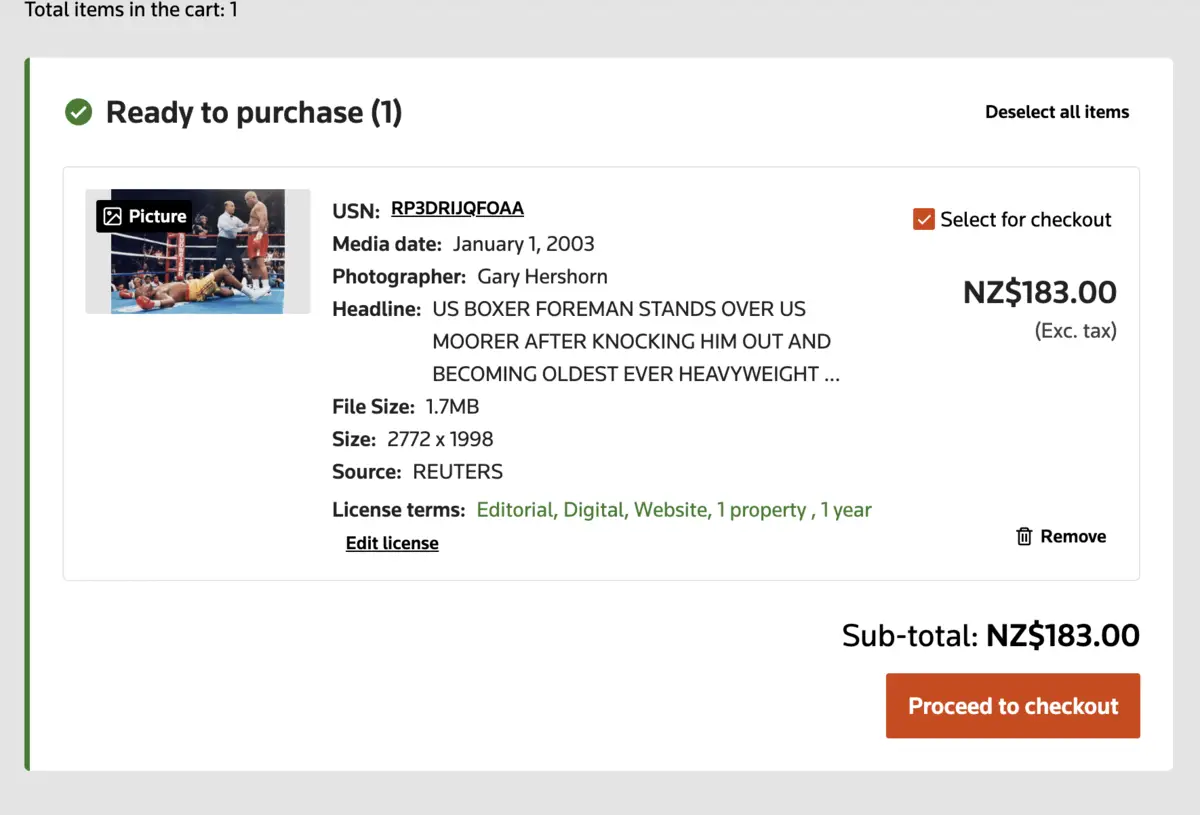
Reuters’ own official pricing portal proved that a legitimate license for the exact image I used cost $183 (assuming a one year license). At worst, $50 more for a lifetime editorial licence.
Yet PicRights was demanding $700 - nearly four times the actual value, when apparently they only seek to recover what was lost ($183 + GST) or a figure ‘based on’ that value at worst.
I screenshotted the Reuters pricing portal (unfortunately I can’t find the screenshot of the lifetime licence but did note it correctly) and sent it directly to the PicRights compliance officer, offering to pay the actual list price ($183 + GST) immediately to resolve the matter fairly.
As an interesting aside, a few hours later I got an email from a seemingly real person at Reuters Connect, effectively telling me that I shouldn’t be going around trying to find licence pricing for images as they could see I have an outstanding dispute with PicRights (I had used the same business name/email etc in the signup process) and as such they were terminating my access to the platform … in other words I shouldn’t have been able to try and access pricing evidence independently and would I kindly stop sniffing around for evidence.
Shifting the Goalposts: From “Editorial” to “Commercial”
Once presented with irrefutable proof from their own client’s website that completely undermined their $700 demand, PicRights did not apologize or adjust the fee to match reality.
Instead, they instantly shifted their entire argument:
- Reclassifying the Use: Despite initially treating the blog post as standard editorial content, the compliance officer suddenly declared that because the post lived on a business domain (samfrost.co.nz), the usage was now magically reclassified as “Commercial” (which carries far higher base fees). This would be like a police officer summarily deciding that the speeding they just accused you of committing was - when presented with evidence that might challenge their position - in fact a more serious charge with a more serious and costly penalty that could apply.
- Adding “Recovery Costs”: They openly admitted that the inflated figure was not just the license fee - as had originally been claimed - but now included arbitrary “costs of recovery and enforcement”, despite their various website content and social media posts (and earlier email comms) effectively claiming that their charges are just about getting the money back that the rights holder lost out on.
Arguing With A Brick Wall
This experience proved to me that once you enter the PicRights system, you are effectively arguing with a brick wall.
There seems little interest in a good-faith resolution or applying actual market value.
At no point will a compliance officer, based on my experience, take into consideration-or even acknowledge-any previous comments, commitments, or written claims they (individually) or PicRights have made.
My experience (all documented in writing I might add) is when confronted with undeniable proof that directly contradicts their own position, they simply ignore the contradiction, pivot to a new justification, and press forward with their pre-scripted demands.
And if you try to push back to hard (in my case quoting some seemingly clear NZ case law, and pointing out the contradictions made in their various messages) you might get hit with this sort of message - which is clearly a bit of a ruse as I was able to settle the matter after the offer was supposedly withdrawn and everything had been escalated to legal counsel:
“This file has been escalated to external legal counsel. All previous offers to resolve have been withdrawn. “
Clearly, the entire process is a funnel designed to force one of four outcomes:
- You pay the full initial demand ($700 in my case)
- You pay a slightly reduced “prompt settlement” discount.
- You prove you already had a valid license, or can prove that you didn’t actually use the image in question
- They escalate the file to a third-party debt/legal agency.
It seems that at no point will a compliance officer accept a fair counter-offer based on actual market pricing (based on my experience and any evidence I have seen re: other cases) presumably because doing so undermine their commercial model, and the whole crux of the matter is that once you find yourself dealing with PicRights you cannot resolve the loss to the licence holder without PicRights getting its unilaterally-decided-upon share.
Has PicRights Taken Anybody To Court?
In New Zealand, there is no public record I can find of PicRights ever actually taking a small business, individual or other type of website owner to court. I have seen some claims of this on Reddit (where business owners pop up asking about PicRights from time to time) but interestingly I have never seen any of these commenters supply a specific case reference or details when pressed. There are some who claim that ‘sock puppet’ accounts operate on platforms such as Reddit, cropping up conveniently in relevant threads to post very similar, vague messaging about some business or individual they knew (but seemingly cannot disclose) who was taken to court and made to pay massive damages, suggesting you need to pay up. I’ll try to avoid getting too drawn into that conspiracy theory. The company’s entire operational framework relies almost exclusively on out-of-court demands and private settlement pressure. The moment a standard, non-flagrant dispute enters a New Zealand courtroom, the economic logic of their business model risks breaking down. As far as I understand it, under landmark New Zealand copyright case law - such as the Court of Appeal ruling in Eight Mile Style v NZ National Party - damages are assessed under the “User Principle”. This means court awards are compensatory rather than punitive, typically restricting damages to the actual market value of the licence you should have bought (and perhaps legal fees, but these are typically not awarded in full and so it’s entirely possible even a successful case would leave the claimant effectively out of pocket). Because New Zealand lacks a U.S.-style statutory damages windfall system for minor copyright mistakes, it makes potentially little financial sense for a foreign agency to spend thousands of dollars engaging local lawyers to chase a claim where a court might only award them a fraction of that. International precedents tell a similar story: in places like France and the UK, courts routinely slash demands or dismiss exaggerated claims entirely.
The Global Perspective: What Happens When PicRights Goes to Court?
In New Zealand, there is almost no public record of PicRights ever taking a business to court. At least not that I can find. If somebody can point me to any such records I’d hugely appreciate it, and will update this post accordingly. I am happy to credit anybody for such information.
NZ copyright law allows courts to punish flagrant infringement with additional damages, but for a standard, non-deliberate image dispute, it seems an NZ court would rarely award them. Flagrancy has a high bar, e.g. repeatedly refusing takedown requests.
Therefore, companies such as PicRights seemingly rely almost entirely on private settlement pressure because the model quite possibly falls apart if allowed to go further. In other words, there is every risk that PicRights could engage an NZ lawyer, go to court, and then find that the defendant has to pay the underlying image licence and nothing else, and PicRights would be significantly out of pocket or have to pass that cost back to their client.
However, because my blog reaches readers all over the world, it is worth looking at what happens when PicRights’ demands are tested before a judge in other jurisdictions.
This is probably of no bearing in dealing with PicRights in NZ, but is interesting nonetheless.
The “French Connection”
A detailed legal analysis published on the French legal portal Village de la Justice by IP attorney Aurore Bonavia breaks down how French courts have been responding to PicRights claims:
- Standard Press Photos Lack “Originality”: French courts consistently reject copyright claims on routine press, architectural, or event photography, ruling that standardized news framing lacks the creative “artistic choice” required for copyright protection.
- Dismissal of Backup Claims: When PicRights attempts to argue “parasitism” or “unfair competition,” courts reject the claim unless PicRights can prove specific, extraordinary financial investments beyond routine business operations.
- Drastically Slashed Figures: In cases where a technical infringement was found, court-awarded damages were “without common measure” compared to PicRights’ demands-with judges slashing claimed amounts by 50% to 80% or more, awarding only minor baseline economic losses.
In the UK, IP law firm Harper James Solicitors notes that PicRights demands can often be challenged on grounds of excessive delay, fair dealing, or lack of evidence.
In Australia and NZ, legal firms like Sprintlaw routinely advise businesses to treat PicRights demands as commercial negotiations rather than gospel invoices.
In short: international court records show that PicRights relies on out-of-court “intimidation” because if the dispute goes to court, it is entirely likely that whatever is awarded will be below the initial claim (and then the rights holder and/or PicRights is out of pocket).
The question of how this all works in the United States is very different, as there is a default statutory damages regime (as far as I can tell) and so there is a higher risk that you go to court and then find that not only do you have to pay $200 for a licence, but thousands upon thousands in statutory damages, and then the claimant’s costs as well. However, even in the United States I was able to find various cases where the awarded costs/damages were well below what was claimed.
In the United States, it also seems that there is more of a documented relationship between PicRights and a specific law firm which appears to be extremely aggressive in pursuing claims that have not been resolved prior to escalation. Nonetheless, the United States also seems to have more ‘defenses’ available with respect to concepts such as fair use, and also whether or not the image copyright has correctly been filed (I don’t really understand this as I don’t live or work in the United States and therefore can’t spend too much time learning the intricacies of American law … if you are an American reader and can add context/insight here, I’m happy to credit you as such)
The Debt Collection Double Standard
To be clear: PicRights is not technically a debt collection agency, and copyright infringement is governed by intellectual property law rather than debt collection statutes.
However, to a layperson receiving one of their emails, the intent and practice feel strikingly similar to debt collection-except that legitimate NZ debt collectors actually have to follow strict consumer protection rules.
In New Zealand, debt collection agencies operate under the Fair Trading Act 1986 and Commerce Commission guidelines:
- Liquidated Debts Only: A debt collector can only chase a liquidated debt-a fixed, agreed-upon contractual sum (like an unpaid power bill). They cannot chase an unproven, disputed civil claim (an unliquidated claim) and unilaterally decide what you owe. Compare this to PicRights, which declares “you owe us $X”, of which only a small portion of that $X - the image licence you should have paid for - is likely to have any real basis/legitimacy.
- No Arbitrary Admin Fees: A debt collector cannot simply slap a 300% markup or arbitrary “penalty fee” on top of an outstanding debt. Under NZ law, they are strictly limited to recovering actual, reasonable costs incurred during collection.
PicRights exploits a legal gray area. They seem to act like a debt collector by demanding payment for an “unpaid license fee,” but they ignore every rule that actual NZ debt collectors must obey.
Do You Have To Pay PicRights?
The short answer is that while you technically owe fair compensation to the copyright holder for using their work without a licence (outside of certain ‘fair use’ type scenarios) you most likely do not automatically owe the astronomical, arbitrary figure that PicRights demands. PicRights is not a legitimate New Zealand debt collection agency, and they are not chasing a “liquidated debt” - which requires a fixed, agreed-upon contractual sum like an unpaid power bill. They are demanding a unilateral settlement for what is - at least in the opening stages - an unproven, unliquidated civil dispute. As with any other private company in New Zealand, they also have no authority to issue ‘fines’ in the conventional sense. What you are being presented with is essentially an invoice, carrying the underlying message: “Pay us this requested amount, or we will try to pursue you in court for copyright infringement on behalf of our client”. Ultimately, how you handle their demand comes down to a pragmatic business assessment. Many business owners choose to pay up, or try to negotiate a reduced fee and then pay that, simply to buy peace of mind and eliminate the administrative headache (which is the path I ultimately took, as I admit to having made a mistake). On the other hand, a huge cohort of recipients simply ignore the correspondence entirely. Given that these enforcement companies rely on casting a wide net, dropping the matter after a few template escalation emails is often cheaper for them than attempting to pursue a dead end across international jurisdictions.
Why Did I Settle Then?
If their arguments were so inconsistent, why did I ultimately sign a settlement agreement and pay a reduced sum?
- Doing The Right Thing: Ultimately, I made a mistake. I used an image that I did genuinely believe I was ok to use (in the context of how I used it) and while I don’t believe for a nanosecond I committed the next ‘Great Train Robbery’ I accept I made a mistake and wanted to right that wrong, as I take commercial pride in doing the right thing in my business.
- Commercial Expediency: The difference between the actual license fee and the final discounted settlement figure was less than what it would cost to have my lawyer draft a single formal response letter. Since I had already admitted to using the image, paying a small “nuisance fee” to make them go away was simply a practical business decision. Astute readers will notice that this is basically the crux of the business model for PicRights (find an infringement that is technically, legally sound no matter how minor, and then get a nuisance fee to make the problem go away … the settlement contract/paperwork, which I disclose in full, pretty much says as much).
- Public Interest & Learning: I wanted to see the process firsthand so I could accurately advise my digital marketing clients and document the experience for the public. I was also interested to see what would happen if I tried to settle for a reduced (not disclosed) sum after this offer was supposedly withdrawn because I had tried to negotiate further. Funnily enough they were happy to take my money, quelle surprise. To be honest, the brand exposure alone from appearing in an NBR article is probably worth more - to me - than the settlement I paid and I have been able to provide some useful advice to various clients.
(Note: As part of the settlement agreement, I agreed not to disclose the exact final dollar figure paid, or the final settlement terms, which is why specific numbers are redacted here)
Should You Reply Or Ignore PicRights?
Disclaimer again: I am not a lawyer, and this is not legal advice.
Whether you reply (and comply, or argue) or ignore is entirely up to you, and your legal advisor if you choose to engage one.
You do not have to look far to see that many recipients of PicRights’ demand letters “solve” the problem by ignoring it and hoping it goes away - which, after various follow ups, does typically seem to be the case.
In fact there are various websites, blogs, social media posts etc I’ve found that document this, share advice on how to best ignore the claims and so on. I’ve seen far more posts along the lines of “I ignored them, got a few threatening letters and emails, but nothing ever came of it” than I have any cases where the recipient has wound up in financial ruin from ignoring things.
In the NBR article I featured in, another agency owner actually disclosed that this is what they have done with a client who has received the claim, here in New Zealand; effectively ceased communicating with PicRights and many months later, nothing further has come of it.
Even the lawyer I consulted with as a general discussion on the topic to give me some insights for this article said that they typically advise clients to ignore all comms (beyond offering to pay the underlying licence fee immediately and confirming removal of the image) because they are yet to see an example of PicRights escalating in New Zealand as they claim they will, and ultimately it costs their clients more money than it’s worth to use their services to negotiate.
Also don’t forget that in this day and age of heightened awareness of phishing and scamming attempts, most right-minded people would take one look at a PicRights demand email (maybe do a quick Google and see the screeds of one star reviews across Google My Business, Trustpilot, Facebook, Reddit etc) hit the ‘spam’/’phish attempt’ button in their inbox to report the message, and probably never see any follow up demands or escalation messages, and never think any more of it. I must admit that I initially thought the same.
Once again I’m not saying whether ignoring their messages is the right course of action (and it differs from what I did) but there is clearly a significant cohort of claim recipients for whom this is the only workable way out of the situation due to financial constraints.
Because of the way PicRights (and similar organizations) work, casting the net as widely as possible to find as many infringements as possible no matter the circumstances, a lot of different types of businesses, organizations and individuals are caught up.
At the end of the day, I run a business and from a basic moral/philosophical standpoint it’s much easier to understand why a for-profit business owner might be more inclined to pay up (or at least engage) than someone who has - without a single shred of commercial intent arguable - used an image on a hobby project blog, or church website or whatever.
Doing some reading online, a lot of the forum posts, Reddit posts etc that ask ‘do I need to reply to PicRights’, ‘can I ignore PicRights’ or “help, what the f**k do I do I can’t afford this’ are from private individuals or representatives of effectively not-for-profit organisations (community groups, educators, churches and religious groups, charities … I’ve even seen an example where a charity set up for a seriously unwell child was pursued, apparently wrongly, by PicRights because of the use of an image of said child where there was a disagreement over who owned the image).
Interestingly, on Reddit there appears to possibly be a bit of astroturfing from accounts aligned with various post-licensing companies that crop up in every thread encouraging the poster to pay up or else.
It’s a lot easier to understand why private individuals and non-commercial entities are going to be more inclined to try and ignore any claims, because the truth is they probably do not have the money to pay what is demanded, which - as I’ve shown - is massively out of whack with whatever the image licence should have been. A $700 bill, showing up unexpectedly (and that is at the low end based on what I’ve seen) would break many household and not-for-profit organisations’ finances.
And then in the context of business owners, to put it bluntly, most remotely successful businesses aren’t in the habit of paying randomly-demanded invoices.
Whether you should or not ignore PicRights and hope the matter goes away (which it most likely will by the sounds of things) is a matter of risk tolerance and personal/professional ethics.
On one end of the spectrum, you can argue that being asked to pay some arbitrary bill to ensure a component of it makes the rights holder whole for your improper use of their images is a fair outcome (‘FAFO’ as the saying goes …). One of the arguments I’ve seen is that if you were to shoplift an item
To image creators and rights holders, it’s not hard to understand this perspective - the attitude being that if PicRights can recoup lost revenue, whatever PicRights gains in the process is rightly deserved. In other words, if you are subjected to financial torment because you used a stock image on your community yoga class website without paying for it, then you have ‘sowed the wind and shall reap the whirlwind’. If you are left utterly bereft after paying up, then so be it. If you are driven to madness from the stress of it, then so be it - you’ve reached the “find out” stage of F Around & Find Out.
On the other hand, you can argue that seizing upon typically minor, non-commercial use of images and then demanding enormous sums of money to make the problem go out of the way, is unacceptable and unreasonable, and therefore one is within their rights to simply ignore such egregious requests knowing that because the cost of pursuing a claim via lawyers and then via court is potentially very expensive (and may result in a loss, not a profit - particularly in jurisdictions without statutory damages regimes) you are most likely going to be able to get away with it.
The truth, presumably, is somewhat open to interpretation and sits between these two extremes.
What Does The (NZ) Law Say?
From the research I could do, in New Zealand the landmark Court of Appeal ruling in Eight Mile Style v NZ National Party [2018] (the “Eminem case”) established that damages for copyright infringement are based on the User Principle:
- Compensatory, Not Punitive: Damages are generally limited to a “hypothetical license fee”- what a willing buyer and seller would have agreed upon at the time. I take this to mean that if I could have bought an image licence for $183, then that is the hypothetical licence fee. By contrast, post-licensing companies routinely cite high legal maximums or worst-case statutory scenarios to pressure people into paying far more than an NZ court would actually award.
- No Arbitrary Admin Surcharges: NZ law does not give private enforcement agencies the right to unilaterally add massive “compliance” or “recovery” fees onto standard licensing costs. If my memory serves me correctly, this is how I’d got out of a few Wilson parking charges in the past before some judge decided to go with the idea that driving past the sign on the way in to the carpark constitutes you accepting all the terms (basically I’d argued ‘yes I’ll pay the lost fee for the free parking I overstayed - which is precisely $0 - but I’m not paying some arbitrary compliance fee’).
This is alongside various other statutes, case law examples etc which all seem to point towards a basic position of:
In theory you could find a court forces you to pay additional damages for copyright infringement, but in New Zealand this is very unlikely for non-flagrant copyright infringement (where you comply with the removal request and don’t keep doing it) and for a standard image licence dispute the most likely outcome would be that PicRights would be awarded the licence fee that should have been paid.
When I consulted an IP lawyer after the fact, their general perspective on handling PicRights in NZ was illuminating:
- Never admit wrongdoing upfront in an email. Although I’m not going to share the contents of the NBR article, the lawyer (a different one) they interviewed for that piece made the same recommendation. You’ll note I didn’t do this bit right.
- Identify the actual license fee value independently. I did this, but it didn’t do me much good. However, in the NZ context at least it is useful if things were to escalate as - in theory - that is about the maximum you’d be on the hook for.
- Offer to pay the genuine license fee to establish that you acted in good faith to make the copyright owner whole. This makes good sense to me, and is what I had done. My understanding being that a New Zealand court is much more likely to look favourably on a defendant who has made a clear, genuine gesture to ensure the rights holder is not out of pocket before valuable court time and resources are tied up (and, on the contrary, may look unfavourably on a claimant that is using the legal system to try and profit)
- If they reject it and demand arbitrary enforcement fees, consider disengaging until (or unless) an actual licensed NZ lawyer contacts you, or you receive a formal court summons. Their perspective being that a bona fide NZ lawyer/law firm is going to be much more amenable to good faith negotiation, as they are likely to know that escalating to court is simply not worth it as the potential “reward” will likely be far less than any costs, which may not be recoverable. After all, part of what lawyers are meant to do is counsel their clients on what is and isn’t possible within the framework of the law, and you’d hope a sensible New Zealand lawyer would take the position that a significant damages award is unlikely, and so it’s better to settle.
From everything I can gather, because New Zealand lacks a “statutory damages” windfall regime for minor copyright cases where there is no repeated, egregious behaviour by the infringer (i.e. you made a simple mistake and you fixed it immediately) it is rarely economically viable for a foreign agency to spend thousands of dollars in legal fees chasing a small claim in a NZ court.
Once again, the entire model is built around the notion that you won’t want to risk finding out the hard way …
The OneMusic Parallel: Licensing vs. Speculative Invoicing
In New Zealand commercial circles, business owners sometimes compare PicRights to OneMusic (the joint licensing initiative between APRA AMCOS and Recorded Music NZ that licenses music played in commercial premises like cafes, gyms, and offices). OneMusic has far more ‘presence’ in New Zealand, and a quick Google search reveals far more discussion about their legality, practices, reputation and so on.
You may also see this comparison made on platforms such as Reddit, where business owners periodically surface asking about PicRights and similar companies, and then somebody inevitably comes along and makes a comment along the lines of “OneMusic always wins when they take businesses to court in NZ, so you need to pay up to PicRights/[insert image post-licensing company here]”.
As an aside, it seems that cases where OneMusic has won large damages in NZ court typically involve businesses that have ignored repeated requests to either pay for a licence or stop playing music without one, and have then avoided all attempts to resolve the matter before it ties up valuable court time and resources (thus meeting the threshold for ‘flagrant’ copyright infringement).
It’s an easy comparison to make on the surface - both deal with copyright compliance - but in practice (at least as far as I can tell) they operate very differently.
- How OneMusic Operates: If OneMusic identifies that your workplace or place of business is playing music without a licence, their primary goal is to enforce ongoing compliance. They contact you to explain the legal requirements under the Copyright Act 1994, help you calculate the standard annual licence fee based on your business size (which is published clearly on their website) and sign you up as an ongoing licensee. I can imagine receiving an unsolicited contact from OneMusic would be very frustrating (even “on the nose”). There are certainly many complaints about this online. You don’t have to look hard to see questions persisting about their conduct, as well as issues around how the changing nature of music creation and distribution should affect licensing. I don’t want to get drawn into that, but the more obvious difference is that (as far as I can tell) their primary objective in sending out letters/emails to businesses is to get them to sign up for an ongoing licence at a set, published fee per annum, as opposed to imposing some arbitrary sum to cover past activity.
- Another thing to note (as far as I can tell) is that OneMusic does not pursue non-compliant, un-licensed private usage of music. For example, if you post a video to your LinkedIn profile that happens to include licensed music, they aren’t going to come after you (that’s not even in their remit - it’s really about ‘public broadcasting’ of music in commercial premises and other physical public spaces)
- How Image Post-Licensing Operates: Companies like PicRights are not trying to onboard you as a long-term, happy customer. They engage in what many consider to be ‘speculative invoicing’, even copyright trolling. They find a single, historical, one-off image usage - no matter how inconsequential or minor - and demand a massive, pre-ordained penalty (often 3x to 4x the actual licence cost - if not higher) under tight deadlines, threatening even worse “punishment” if you decide to fight them or ignore their demands. Whatever arbitrary amount they extract above the underlying licence fee is kept as profit for the middleman.
From what I can gather, OneMusic wants to get you properly licensed for the future (and, worst case scenario, wants you to pay for the actual licensing fees you should have paid - although I am not sure if this typically happens or if they just try to get you signed up going-forward); whereas image post-licensing companies want to extract a high-pressure lump sum for the past.
How To Respond To PicRights?
Before doing anything, let me repeat my standard disclaimer: I am not a lawyer, and nothing here is formal legal advice. If you do find one of these notices landing in your inbox, the absolute first step is to take a breath and verify the claim. Check whether you actually used the exact image referenced - automated crawlers make mistakes far more often than these companies care to admit - and if you did use it improperly, remove the image immediately. Crucially, legal professionals consistently advise that you should never admit liability or apologise upfront in your initial email correspondence (a mistake I made, as at the time I had no understanding of the aggressiveness of the post-licensing business model and figured I was merely engaging in a routine, ‘good faith’ negotiation). Instead, conduct your own independent price discovery by going straight to the rights-holder’s platform to find out what a legitimate licence actually costs … as you won’t be given one otherwise. Armed with that figure, you can attempt to offer the genuine licence fee to settle the matter in good faith and prove you want to make the rights holder whole. Just be prepared for them to reject it and shift the goalposts to justify their inflated enforcement fees. If they refuse to negotiate reasonably, some IP lawyers suggest making a written offer to immediately repay the underlying licence fee without delay, and then disengaging entirely until - or unless - you receive a formal letter from a licensed, local New Zealand law firm or an actual court summons. The main thing to consider is that unless you can prove you do have a licence for the image, or a clear mistake has been made, you are probably on a ‘hiding to nowhere’ if you try to negotiate. As such, there is probably little to gain in responding (outside of the noted approach of offering to repay the licence fee in full, which demonstrates you have acted in good faith to resolve the underlying loss to the licence holder).
How NZ Businesses Can Protect Themselves
To avoid falling into the PicRights trap, here is my practical checklist:
- Audit Your Website & Social Media Profiles: Run an internal audit of all images on your site-especially old blog posts and media folders. If you can’t verify the license, or that you made the image, delete the image immediately. A tool like Screaming Frog can help you to quickly audit images on your site by producing a comprehensive list of all image links, which you can then review and take action accordingly.
- Establish Strict Image Sourcing Policies: Ensure staff and contractors only use self-taken photos, licensed stock with documented receipts, or AI-generated imagery.
- Contractual Protection with Vendors: If you hire a web design or marketing agency, ensure your contract explicitly states they must hold licenses for all imagery supplied and will indemnify you against third-party claims. I have seen this cause problems (based on my research). E.g. you engage an agency to build the site, some employee of said agency uses random images in the build, and then you get stung with the bill!
- Skip Standard Stock Imagery: Given the rise of automated copyright trolling, the risk-to-reward ratio for traditional stock imagery is broken. Consider switching to custom photography or AI generation to eliminate risk entirely. I’m the first to admit that a lot of AI imagery is rubbish, but a lot of stock imagery is rubbish too. And at least ChatGPT won’t send you a threatening email demanding lots of money for improperly using one of the images you’ve made on their platform.
- Do Your Own Price Discovery & Usage Verification: If hit with a claim, always look up the image on the client’s actual platform (e.g., Reuters Connect) to document the true market value before responding. In fact, before this you should verify that their claim is even grounded in reality. In my research, I’ve seen numerous examples of claims received from various post-licencing companies, where the image being claimed differs to what was actually used (presumably some automated discovery error) or where there is some other clear technical mistake in the claim. Some of these might be people not wanting to admit the truth, but there are enough very legitimate sounding examples of this to warrant at the very least verifying that what you have been accused of is true. Notwithstanding the only evidence that seems to be provided - at least based on my experience - is a grainy, lo-res screenshot of your website (you’ve got to wonder how reliable that is as evidence, as an aside). In other words, PicRights is not some legal or moral authority, so do feel free to question and challenge their assumptions as is your right.
Conclusion
At its core, copyright law exists to ensure creators and rights-holders are fairly compensated when their work is used.
That is a principle I fully support - although I do believe that in the context of how the Internet is used by many there is probably an argument for a revision of copyright laws to accommodate the ‘innocent-in-intent, non-commercial re-distribution and modification’ of visual content. In other words accepting the reality that a significant aspect of mainstream Internet use is using images sourced without regards to licensing in order to aid communication, but with no underlying profit motive. Just look at the rise of meme culture, for example, which I’d assume has all sorts of copyright implications but is a fundamental aspect of the modern Internet and isn’t going anywhere … and frankly is one of those “is what it is” phenomena.
What I cannot support is an automated, high-pressure enforcement system that uses shifting goalposts, vague legal threats, and arbitrary markups to extract money from not just businesses, but individuals and not-for-profit organisations that are often of very limited means. I simply can’t get on board with the idea that it is fair to sting some university student for thousands of dollars, for example, because they used an old image in a project blog/website.
Fundamentally, I do not agree with a business model where an infringer (who is classified thusly on mere technicality, rather than with any consideration given to intent) is placed in a position where the only way to fix the situation - short of ignoring it and hoping the problem goes away - is to pay a totally arbitrary, hugely inflated sum to allow a third party with whom they have no contractual relationship or agreement to profit, in order to make whole the underlying rights holder. I cannot think of any other circumstance where this is a “thing”, let alone considered acceptable or reasonable.
As I said at the outset, I do not believe that two wrongs make a right. To put it another way, is demanding arbitrary sums (sending speculative invoices on the threat of legal action and even more crippling expense, of which only a small, non-disclosed percentage is remotely ‘legitimate’) with absolutely zero consideration given to any mitigating circumstances, and zero consideration given to previous statements you’ve made that might contradict the value of your claim, really any more ‘moral’ than what is typically unintentional, minor, non-commercial copyright infringement … I guess that depends which side of the ledger you sit on.
If you receive a demand from PicRights, don’t panic. Remember that you’ve been sent nothing more than an invoice of which an underlying component may be legitimate. Don’t forget that the strategy is to get you so frightened of the potential consequences of opening that first email, that you pull out your credit card and pay there and then.
Take a breath, verify that you actually used the image (the exact image, as claimed) , verify the real value of what was used, seek qualified legal counsel if needed, and remember that you have rights under New Zealand law.
References & Further Reading
- Village de la Justice (France): PicRights face au juge français : décryptage d’un contentieux entre droit d’auteur, parasitisme et abus de droit by Aurore Bonavia (translation provided by Gemini, and what remains of my university level French after nearly 15 years out of practice)
- Harper James Solicitors (UK): How should I respond to a PicRights copyright infringement letter?
- Sprintlaw (New Zealand / Australia): What To Do If You Get A PicRights Copyright Infringement Letter In NZ
- Andrew Brown Kings Counsel (New Zealand): The New Zealand National Party & Anor v Eight Mile Style, LLC