Is Your Business At Risk Of An Accidental Image Copyright Infringement Demand? 4 Common Scenarios Explained
Following up on my recent article detailing my personal experience dealing with PicRights - and my interview with the National Business Review (NBR) - the response has been overwhelming.
I’ve had many hits on the article, and some messages from readers thanking me for sharing my experience.
It turns out that a massive number of business owners in New Zealand, Australia, and around the world have had their own stressful run-ins with post-licensing enforcement agencies.
In fact (maybe it is confirmation bias) I am seeing posts across various social media platforms with ever-increasing frequency, talking about run-ins with companies like PicRights.
In my first article, I laid out my own situation in detail. You can (and should) read it here.
Although it is relatively long reading, I go into a lot more detail about the way companies like PicRights operate, answer common questions such as whether PicRights is a scam (along with other image post-licensing companies) and generally discuss what you need to know about this burgeoning “industry”.
This article focuses on something different - various scenarios in which business owners may be exposed to image copyright claims, without having even the vaguest awareness that their behaviour/activity has exposed them in such a manner.
I DID Make A Mistake - You May Not Have (But That Doesn’t Change The Outcome)
Let’s start with some context. In my specific dealing with PicRights, I dropped the ball. I make no attempt to claim otherwise.
The scenario was a simple (and probably fairly common one) - I grabbed an image, in this case a photo of George Foreman knocking out Michael Moorer to become the oldest heavyweight champion, off the internet for a blog header, didn’t secure a licence (as I wrongly assumed ‘no big deal’ due to this being a specific, very old image I had seen posted thousands of times online) and forgot about it.
This is probably the most common scenario in which a business owner, webmaster or individual has a run-in with an image post-licensing company like PicRights - foolishly grabbing any image and using it without thinking about the licence.
When PicRights pinged me, I immediately knew I’d made a mistake. I have never made any attempt to claim otherwise.
My fight with them wasn’t about pretending I was innocent - I immediately admitted wrongdoing.
However, my fight was about calling out their shifting goalposts (e.g. claiming I used the image editorially, then changing that to a claim of commercial usage when an editorial licence contradicted their own statements) their refusal to acknowledge market reality, and an initial $700 demand for an image that Reuters actually sells for $183 (because, fundamentally, what gives the right to claim a wholly arbitrary sum if the damage done is only $183 and I offered to pay that immediately without delay?)
In my case, at least I had that moment of: “Ah damn, okay, I actually did something wrong here.” … I just don’t believe two wrongs make a right, or that there should be arbitrary penalties for things imposed by anybody. There are various “moral questions” that I believe need discussing.
This follow-up article is about a prospect that is far more terrifying - and it isn’t some made up yarn. This is happening to businesses in New Zealand and other countries every single day.
What happens when you have ZERO awareness of wrongdoing? What happens when you wake up, open your inbox, and find a $750, $2,000, or even $15,000 demand from an enforcement agency like PicRights - for a website or social feed where you had ZERO understanding that you were placed at risk?
In these scenarios, you didn’t download a random image off Google. You didn’t cut corners. You did everything a reasonable business owner is supposed to do: you hired professional agencies/freelancers, trusted product suppliers, or relied on staff and contractors acting in good faith.
Yet, because of how copyright law works, the financial and legal axe falls 100% back on you, and you are left holding the bag for what is somebody else’s mistake - and a mistake they probably never realised they made, which has now become YOUR problem.
Why You Need To Take This Seriously & Avoid Having A “Run In” With Post-Licensing Companies
Before looking at the specific trap scenarios, it’s worth asking: why is it so vital to prevent this from happening in the first place? Why can’t you just “deal with it if it happens”?
Because getting caught in the PicRights (and any other image post-licensing) web hits your business with an unpleasant, potentially crippling, Triple Threat:
-
Money: The obvious one - who (particularly in the current economic climate) - wants their business subjected to additional, harsh expenses - even if it is nothing more than a speculative invoice you might not need to pay? Claims can range from hundreds through to thousands. For a small or medium Kiwi business, an unexpected demand can cripple monthly cash flow. Even a “modest” demand could, for example, buy you a Google Ads audit from yours truly - which could save your business even more money (how about that for a subtle plug) Even worse: because their crawlers are automated, what happens if their bots find 10 old blog posts at once? You could conceivably wake up to $10,000+ in demands overnight. Add on lawyer fees if you want to dispute things more robustly, and the costs will skyrocket further.
- Bear in mind that the entire “business model” of these companies is to send an initial, speculative invoice for a sum that includes a smaller sum designed to pay the copyright holder (their client) what should have been paid, and the rest is all profit for the enforcement company. E.g. you might be asked to pay $1000 for a $50 image, and my experience is that the enforcement company will go out of its way to hide from you what the image licence fee should have been (to the point they will actually lie to you about it). However, the second component of the business model is the threat that if you don’t ‘pay up’ the arbitrary speculative invoice amount, you’ll be taken to court and have to pay vastly more.
-
Stress: Their business model is fuelled by what is basically legal intimidation. Receiving formal notice threatening lawsuits, legal fees, and court summonses creates immense mental anxiety, and is quite literally designed to stress you into paying the initial demand or any kind of reduced settlement offer. Running a business is already stressful enough without a global enforcement firm trying to bully you into submission for what can be (as I am about to demonstrate) a mistake you may not have even known you have made.
-
Time: Who has the time to deal with a recalcitrant enforcer that basically refuses to negotiate in good faith? Once they have your card marked, it will be a time-consuming exercise to extricate yourself unless you pay up immediately or ignore from the outset (risking further penalty and stress) Digging through 10-year-old email archives, searching stock portals for true list prices, and drafting dispute responses burns precious hours that you should be spending running your actual business.
The main thing is to avoid being in a position where you risk one of these pesky, automated image copyright claims. Because once you’ve had one of these emails land in your inbox, getting it to go away (short of paying what is demanded) is much easier said than done. Once your ‘card is marked’ you are going to have some stress and wasted time, even if you have done nothing wrong.
The Legal Trap: Strict Liability Meets AI Automation
To understand why innocent business owners get trapped by PicRights and image post-licensing companies - even when they have absolutely no reason to believe they have done anything wrong (and nor would any layperson consider it wrongdoing) - you have to understand a fundamental mechanism of copyright law: Strict Liability.
Disclaimer - what follows is my layperson, non-lawyer interpretation of Copyright Law and how it is typically used and applied. This is based on the best of my research and understanding, but should not be relied upon as an authoritative source of information.
Unlike criminal law - where intent matters - copyright law typically doesn’t care if you acted in good faith, or if you had no reason to believe you had done anything wrong.
To be found guilty of theft in New Zealand, for example, you must have the intent to have wrongly taken the item in question (in effect) and by extension, it is a valid defence to a charge of theft if you had a genuine reason to believe you were entitled to take the item.
Believe it or not, I actually trained for a while to be a police officer (before going in a different direction career-wise) and I can still remember learning the ins and outs of the Crimes Act and the importance of there being both an actus reus - the ‘bad act’, e.g. taking a chocolate bar off a supermarket shelf and walking out without paying - and the mens rea - the ‘guilty mind’, which is an essential element of the crime itself, wherein the offender knows they have done something wrong. Without the mens rea there is no crime, in effect. As an aside, I feel like I was the only trainee I knew who enjoyed the legal bookwork far more than the physical stuff like learning to use a collapsible baton or pepper spray … perhaps this explains why I never really “gelled” with the whole process.
For example, if your boss tells you to go drive to a location and pick up an item that is sat outside because it is company property that needs recovering, and then it turns out that your boss was actually instructing you to steal something, you’d have a solid defence (you had been told - on good word by somebody in a position of authority whom you have no good reason to question or mistrust - that you were simply picking up something your employer already owned).
Copyright law is different. The act of downloading an image and then publishing it - even if you had no ill-intent, even if you genuinely thought you had the right to use it (i.e. somebody else told you it was a ‘free to use’ image where no licence was required and you had every reason to believe them) - none of it matters, outside of rare instances where you could prove a “fair use” defence which is easier said than done, and seems rather dependent on jurisdiction.
As I outlined in my other article about PicRights, this is a key component of their business model. Because copyright infringement is both easy to prove and very hard to defend against (because effectively all that matters is the ‘technicality’) the foundation of claims by these enforcement companies - who work on behalf of their clients - are typically very watertight from a legal perspective.
The grey area comes in the extent to which a company like PicRights is “entitled” to demand wholly arbitrary sums of money that are utterly divorced from the underlying damage to their client - on the threat of legal escalation - unless you pay what they demand, even if you make a good faith attempt to resolve such as offering to pay the licence fee without delay (my layperson assumption is that this is the reason they don’t seem to go to court in NZ … because although it would be easy for them to win the copyright infringement case on a technicality and there is established precedent that you’d need to repay the licence fee - you have to wonder to what extent a New Zealand court would be on board with an unsolicited third party enforcing arbitrary penalties with presumably no legal authority to do so. After all, in my experience a company like PicRights won’t even tell you what the licence fee should have been … you have to go hunting for it yourself).
The other issue is that, in most circumstances, the “publisher” is the responsible party, and as the business owner that is basically you (or your company).
If the image lives on your website, blog, or social media channel, you are legally responsible, or as near as makes no difference.
Combine strict liability (it doesn’t matter why you did it, just that you did it without the right permission or licence to do so) with the ultimate publisher being responsible (you) along with modern AI web-crawling technology - which can scan millions of websites, buried PDFs, and old social posts in seconds - and you have a predatory environment where completely “innocent” business owners are being blindsided at scale … and it appears this is happening more and more every day.
I’d bet the farm that the vast majority of Kiwi businesses - particularly those that have been in business for a while - probably have some kind of non-compliant, improperly-licensed imagery lurking on their website, or social media channels, or within files hosted on their web server (believe it or not I’ve even heard of businesses getting pinged for images used in ‘internal’ documents e.g. sales training decks, which have been hosted online in such a manner where the file isn’t meant to be public but a scraper can find it).
As such, you need to protect yourself by being aware of the scenarios in which a seemingly innocent business owner such as yourself might find themselves in a situation where an image copyright demand email lands in your inbox, and you are caught out on a tedious technicality.
Here are the four high-risk scenarios every business owner needs to watch out for.
Scenario 1: Employee or Contractor Error
What: A staff member, intern, or freelance social media manager downloads an image off Google Images to create a quick graphic for your business Facebook, Instagram, or LinkedIn page. Three years later, that employee has left the company, but the post remains live in your feed (or on your website). An automated image scraper picks up this image, and you are presented with a copyright infringement demand letter because of it. You had absolutely no idea an unlicensed image was used (because you trusted the employee/contractor) but you are now footing the bill.
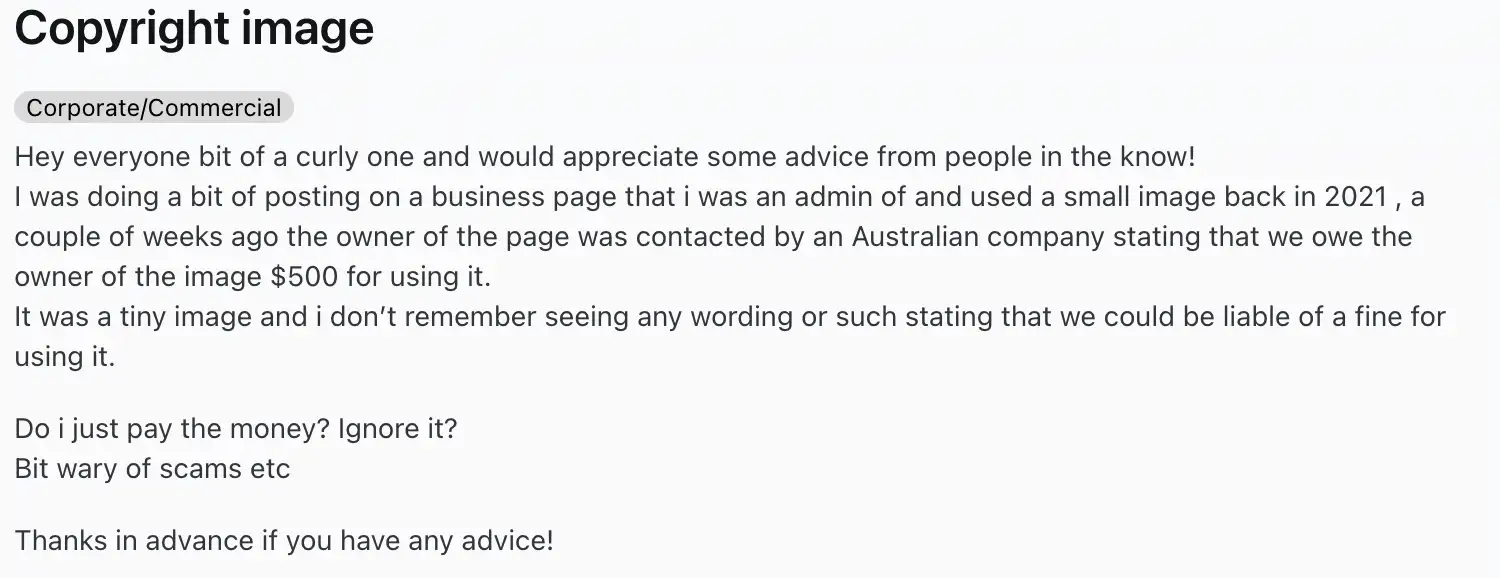
The Real-World Example: I recently came across a thread on the r/legaladviceNZ subreddit. A worker - possibly a contractor, they didn’t disclose - posted asking for advice after their former employer/client received a $500 demand from an image enforcement agency for a Facebook post made years prior. They were rather shocked to be hit with a claim for an image that was posted in the dim and distant past, which probably hasn’t been viewed in years by any real human.
Why It Falls on You:
-
Under copyright and corporate liability laws, the business entity that operates the social page is strictly liable for the infringement (I’d assume that social media platform ToS basically indemnify them against any copyright infringement you make on their platform, in other words if your business page on Facebook publishes an infringing image, although Meta technically “owns” the Facebook page they will have watertight terms - which nobody has ever read, let’s face it - which ensures you are responsible).
-
“I didn’t approve the post” or “I didn’t know my employee used that photo” is, unfortunately, not a valid legal defence.
-
Or, at the very least, an image post-licensing company will have precisely zero interest in hearing your argument. If you go back to them and explain you didn’t post the image, you had no knowledge of it, or you otherwise didn’t approve it, they simply won’t care.
-
Good luck recovering that money from a former staff member. Unless their contract explicitly allows for recovering damages caused by this sort of “negligence”, employment law in New Zealand and most jurisdictions makes it virtually impossible to claw those funds back (if you are an employment lawyer, feel free to chime in here with your expert opinion and I’d be happy to reference you - even if you can just generally comment on the extent to which a business could recover a copyright infringement demand from an employee who made the error).
-
You might have more luck trying to recover from a contractor. I’d assume, however, that you’d have to try your luck in the Disputes Tribunal for this, and I would also assume there is no guarantee of success in this regard.
Scenario 2: The Web Agency or Freelancer Deliverable
What: You hire a web design agency or freelance developer to build a new website or design digital ads. They hand over a slick, finished site, or a new site of banner ad files. Unbeknownst to you, a designer “lifted” stock images off Google or recycled imagery from a previous client’s site without purchasing the proper commercial pass-through licence.
The Real-World Example: I know of a specific (albeit relatively unusual) case where a web designer built a website for a client on a complimentary basis - as there was meant to be some other form of commercial relationship by which the designer would effectively be compensated at a later date. In effect, the “client” was given use of a free website that was built specifically for their benefit, but the rights to the imagery were exclusively licensed to the designer who built, operated and maintained the website. Think of it like a ‘website rental’ but provided for free, on the quid pro quo that paid work would be forthcoming in the future, but also on the proviso that the website and any image rights were owned by the designer. There was a falling-out between the two parties, and the client engaged a different web designer to build a new website. This new designer uplifted various images from the old website and re-used them. However, the licence was no longer valid - because the licences belonged to the old designer - and the client is the one who would foot the bill if a post-licensing company came calling.
A simpler example (and more common one) would be where you engage a designer e.g. contract graphic designer to make a flyer for you, and they include an image as a component for that flyer for which they did not secure the appropriate licence.
Why It Falls on You: When PicRights’ bots crawl your new site, they don’t email the web agency or designer who built the site; they email you.
Even if you paid the agency thousands of dollars for a turn-key project, the legal claim is lodged against the site owner.
Unless you have robust, documented proof of licensing handed over at launch, you are stuck arguing with an enforcement agency that has zero interest in hearing that “the agency made me do it”.
Scenario 3: “Technical Infringement” Via Link Or Content Sharing
This is another scenario I’ve seen crop up in various discussions online, and is a risk factor because many businesses share (via their website or social channels) links to other sites - or things like documents - which can include images.
What: Your business makes commentary on various industry matters. As part of this, you upload to your website a copy of a third party industry report which is a topic of hot contention and debate in your commercial field, as you wanted to embed it in your blog post to discuss. This report contains a copyrighted image, which you have inadvertently ‘published’. A more specific example I have seen of this is a lawyer - commenting on a case, and discussing a specific piece of evidence which involved uploading a PDF to their website. This PDF contained a copyrighted image, and as such the lawyer received an automated claim demand email.
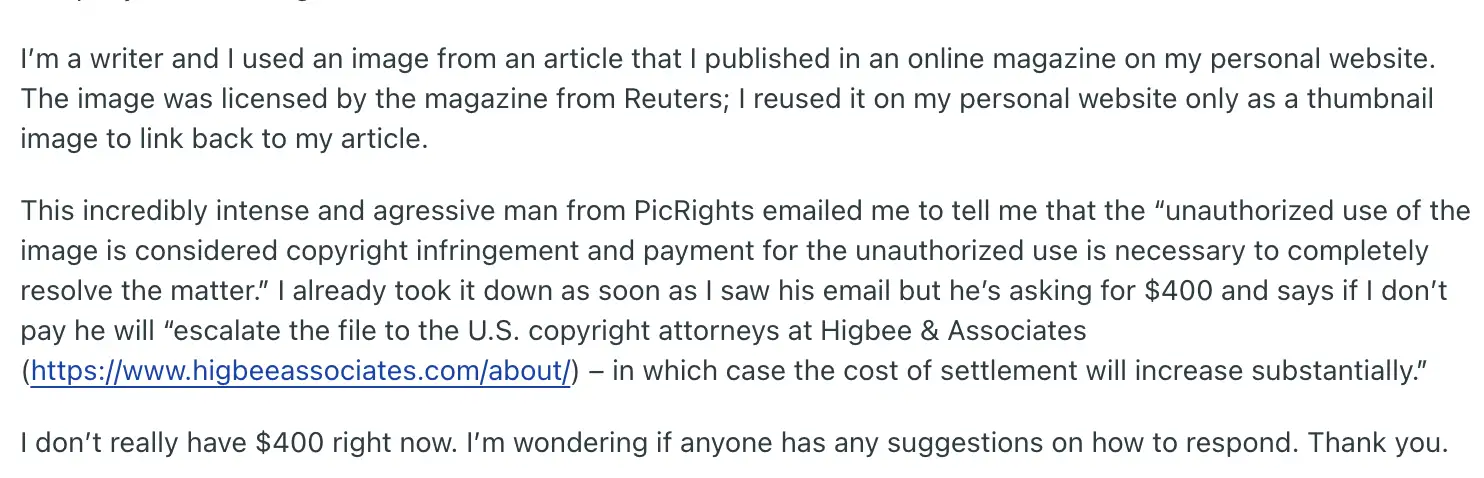
Real World Example: I came across the following interesting Reddit post from a writer who linked from their own portfolio website to an article they wrote for a publication that contained a licensed image. They were sent a copyright claim by a post-licensing company because the thumbnail on their portfolio website linking to their own article featured the copyright image (for which the licence only applies to the site the article originally appeared on). In this case, presumably the writer has uploaded (and therefore published) the thumbnail image on their own web server.
Can You Share Images As Part Of Any Link?
When it comes to automatically generated thumbnail images created by links, the key legal question seems to come down to a technical distinction: where does the image file actually live?
If you paste a link into a social media platform like LinkedIn, Facebook, or X, you are generally on safe ground. Social platforms typically use automated bots to read a target website’s “Open Graph” metadata tags, which publishers deliberately install in their code to tell social networks which image to display when shared. By making their site publicly accessible with these tags, the publisher grants an implied licence for social platforms to pull and render that preview. Because you are simply sharing a text link and the platform handles the preview on its own infrastructure, you aren’t copying or hosting the file yourself.
However, the debate gets much stickier when you post a link on your own business website. Modern website builders or Content Management Systems (like WordPress, Squarespace, or custom CMS tools) sometimes try to make link preview cards load faster by automatically downloading the target article’s thumbnail image and saving a copy directly to your website’s server directory. Or this act of downloading an image and then reuploading as a thumbnail or ‘preview image’ is done manually and deliberately. This is where the risk seems to come in. The instant your server stores that file, you have most likely committed technical copyright infringement by making an unauthorised copy - even if a website plugin did it automatically in the background.
Even if your site doesn’t download the file and instead uses “hotlinking” (pulling the image live from the target site’s server via code without saving it), international courts are deeply divided on liability:
-
The US Position: The landmark Ninth Circuit ruling in Perfect 10 v. Amazon established the “Server Test,” holding that merely linking to or embedding an image hosted on someone else’s server is not copyright infringement because no physical copy exists on your site. However, other US courts (such as Goldman v. Breitbart in New York) have rejected this test, ruling that embedding an image still counts as an unauthorised public display.
-
The EU Position: In cases like Svensson and GS Media, the European Court of Justice ruled that hyperlinking to freely available content is generally fine, but it becomes an infringement if you link for commercial gain or if you link to content that was originally published online without the owner’s permission.
-
The NZ Context: While New Zealand courts have not explicitly penalised pure hotlinking where no file is stored locally (based on any cases I can find, feel free to correct me) images rights enforcement agencies do not analyse legal nuance before firing off automated demand letters. Their image-matching crawlers simply flag any photo appearing on your web pages. If your website automatically caches thumbnail images or embeds third-party visuals, you face an immediate risk of an automated claim - leaving you to prove that your server never actually hosted the file.
Scenario 4: Supplier & Vendor-Provided Marketing Collateral (The $15,000 Spa Banner)
This is perhaps the most egregious scenario of all, and I suspect this type of thing happens constantly in the likes of retail, healthcare, trades, and beauty sectors, with no reseller/vendor/retailer acting in the remotest of bad faith - but nonetheless placing themselves at real risk with no reason to suspect any wrongdoing until it is too late.
What: You are an authorised reseller or service provider for another brand. E.g. you sell electric bike via an eCommerce store, and a supplier offers marketing collateral to help you promote their range. The supplier sends you an official digital media kit - complete with promotional banners, product shots, and social graphics - to help you sell their product on your website. This is something I used to help arrange, for example, in a job I had as an affiliate manager (basically plying our affiliates with resources they could ‘swipe’ and use). You publish the supplier’s collateral in 100% good faith, because you are trying to be a good distributor/reseller/partner and sell more of their product and simply doing what you think is right.
However, it turns out that the supplier never paid for the licence for an image that forms a component of the promotional material they have given you (which, in good faith, you have taken and published on your site). Perhaps they even did pay for the image licence, but only for their ‘internal’ use and the licence is no longer valid when the image is effectively published by you.
Here is where the legal trap snaps shut: standard stock photo licences are almost always non-transferable and explicitly forbid sub-licensing. That means even if the supplier paid for the right to use the image on their own corporate website, that standard licence prohibited them from packing the image into a marketing kit and distributing it to a third-party entity (like an independent clinic or authorised reseller) to publish on a separate, commercial domain. The licence is completely invalid the moment the image is effectively published by you … and because of the technicalities of copyright law, you are at fault.
Alternatively, there is a very real possibility that the supplier simply has no right or licence to the image whatsoever (similar to scenarios 1 and 2). You have to assume most suppliers - unless large enough to have robust legal advice and processes - have absolutely no idea about this kind of thing, or the strict limitations of standard stock licences. Once again, this becomes (at least from the perspective of image post-licensing companies looking for a quick buck) your problem.
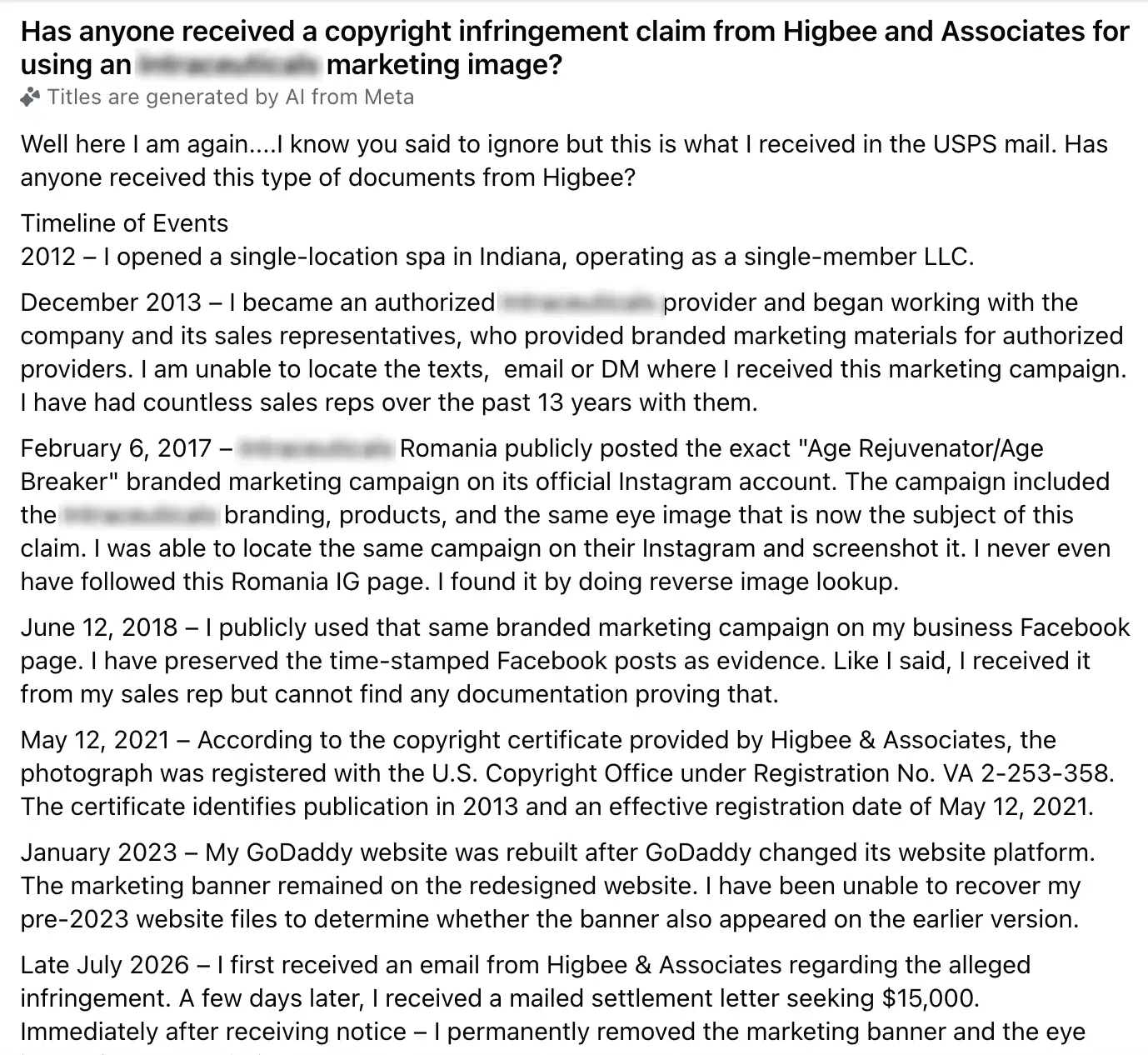
The Real-World Example: In a support group for businesses targeted by one of the major post-licensing companies and their US litigation partners, a spa owner shared a horrific case.
For nearly 15 years, her clinic had displayed a promotional website banner supplied directly by a product manufacturer.
Tucked inside that supplier-provided banner was a stock photo/image of a human eye. It appears that the supplier may never have secured the proper commercial licensing rights to pass that image component on to their resellers via their ‘marketing material’ (or so is being claimed). PicRights slapped the small spa owner with a staggering $15,000 USD demand.
This person is now scrambling to try and get the supplier to help verify the licensing of the banner, while being threatened with legal action and greater costs - in the time it has taken me to write this article, I went back and checked in the group again and it appears that a claim has actually been filed in court.
As you can imagine, this is immensely stressful for them and also confusing as they have no genuine reason to believe that they have done anything wrong (but, due to the technicalities of copyright law, could still be found at fault).
In good faith, this person took marketing collateral provided by a product supplier and used it to try and sell more of that product … nobody would think twice about this, nobody would think from a basic ‘moral’ perspective that this person has done anything wrong.
Why It Falls on You: To an image post-licensing company, it matters not one bit that you took supplier-provided promotional resources/imagery in good faith and assumed that anything provided was fully cleared. Unfortunately, for you (the business owner and inadvertent publisher), it doesn’t matter whether the supplier failed to secure a sub-licence or had no licence at all. You published the graphic on your commercial domain, making you the primary target. When this happens, you might have to urgently revisit your supplier contract to see if you are legally indemnified and if they are required to cover your legal costs.
They pursue small businesses, individuals and not-for-profit organisations like a seagull going after a plate of hot chips - that is to say, relentlessly … because larger targets will be better placed to defend themselves owing to either in-house legal expertise or greater financial resources to pay for lawyers.
How To De-Risk Your Business Today
Because these image post-licensing companies approach copyright enforcement with the diplomatic finesse of Reggie and Ronnie Kray (who, at the very least, had to conduct their ‘protection racket’ in person) - relying on automated pressure rather than good-faith discussion - you cannot wait for a demand letter to arrive before taking action. Because once a demand letter arrives, trying to rid yourself of it is like trying to remove dried dog turd from your shoe.
Here is the three-step framework every business owner should implement immediately:
1. Conduct a “Digital Asset Audit”
Go through your website, active media libraries, and social media channels.
-
Do you know the exact origin of every image?
-
Do you have documented evidence of the origin of every image? An employee saying “trust me bro” is not evidence.
-
If an asset was downloaded off an unknown stock site years ago, or uploaded by an ex-employee without clear licensing records, delete it immediately.
-
Replace it with original photography, explicitly licensed stock, or custom AI-generated graphics. Even the worst of AI slop beats an expensive image rights claim.
2. Implement a Mandatory “Image Provenance Log”
Establish a strict rule across your organisation: No image goes live under any circumstance without a documented licence record. Ensure all staff, contractors etc are familiar with this.
-
Self-taken photos: Logged as original assets.
-
Stock photos: Keep a dedicated folder of purchase receipts and licence PDFs.
-
AI-generated images: Log the tool, prompt, and generation date.
-
Creative Commons: Document the specific licence terms and attribution requirements.
3. Update Contracts with Agencies & Suppliers
Protect yourself contractually before publishing third-party content:
-
Web Agencies & Freelancers: Require that all deliverables include an asset log detailing the licence origin for every image. Insert a clause stating the vendor must indemnify your business against any copyright claims arising from imagery they supply. If the vendor squeals about this, then take your business elsewhere. You might need a lawyer to help draft this, which could be money very well spent.
-
Product Suppliers & Vendors: When receiving marketing collateral from manufacturers, request written confirmation that they hold full commercial pass-through rights for all graphical components. If you are in a position to ‘dictate the terms’ (i.e. the supplier really wants your business) then ask for them to indemnify you via your contract. Once again you might need to engage a lawyer to assist with this.
4. Be Careful How You Share Content
As far as I understand it, doing something like linking to a specific web page from your social media where a thumbnail image is then pulled automatically through is not copyright infringement (I wouldn’t put it past an image post-licensing company to ‘have a crack’ - because there is some grey area here - but there seems to be enough discourse and international case law online to establish the position that this is not copyright infringement in this particular context)
Where this is more likely to become an issue is when sharing a thumbnail of an image - as part of an outbound link - where you have effectively uploaded the image to your own server. E.g. you download the ‘featured image’ from another website’s article (or even include the featured image as part of a screenshot) and then upload this image to help constitute the link.
-
If linking out from your website to another website, try to do text-only links.
-
If you need to include an image, then “hotlink” the image where possible (this is basically where you embed from the source website - which may or may not be possible on your own site).
-
If you need to include an uploaded-to-your-server image, then either source your own (e.g. use AI, find a genuine free-to-use image with documented evidence, or buy a licence) or - if unavoidable - use something like a screenshot you have taken which is easier to argue as “transformative” fair use.
-
The most important thing is to avoid uploading - even if by accident or background process - an image to your own web server.
Final Thoughts
Dealing with image post-licensing companies is, by design, an exhausting, high-stress experience designed to force panic payments.
That is basically the modus operandi - present what is ultimately a speculative invoice (but backed with a genuine, legal position due to documented copyright infringement) on the pain of you suffering even greater stress and expense if you don’t pay up.
In my case, I made a common mistake, admitted it, and fought their inflated charges (but ultimately settled for a reduced sum for expediency’s sake, and also to make amends for a mistake I do admit to having made).
But for the vast majority of business owners caught in these four scenarios I’ve outlined above - which differ greatly to mine - they acted in 100% good faith with zero awareness that they were in the firing line. This is quite different in my view, at least from a moral/philosophical perspective. You’ve gone about your daily business and not even had that common thought process of “this image would look good on my website for this purpose, I’m sure I’m fine to just download it” (a mistaken belief). You’ve simply got no idea whatsoever that you’ve done anything wrong.
I would imagine - in this sort of scenario - it could be even more stressful in some respects than my experience (where I at least have the comfort of being able to accept I did something wrong, I just didn’t agree with their manner of trying to put it right).
No normal businessperson who is dealing with a million things at once would think for a nanosecond about the ‘provenance’ of images uploaded to their website by their website agency. You pay for somebody to build you a website, you assume the images are ok as supplied. Therefore, you’d be flabbergasted to be hit by some claim where - unfortunately due to the technicality of the law - you would be responsible for any “innocent” copyright infringement and then find yourself dealing with one of these hyper-aggressive enforcement companies.
Don’t wait for an automated claim to land in your inbox, threatening your bottom line and causing massive stress as you navigate the unpleasant and frankly unreasonable process of trying to resolve the matter.
Protect your business - audit your media files today, and make sure your team, contractors, and suppliers are held strictly accountable for what they upload, and have a clear and documented process (and ‘evidence log’) of image origin and ownership.